Pilot cohort open
The artwork's digital passport
The artwork's record, assembled from the documents that already exist, sealed at the moments that matter, and verifiable by anyone in a standard PDF reader.
Apply to the pilot cohort- Title
- Confluence
- Artist
- Markellia Demo
- Date
- 2024
- Medium
- Oil on canvas, 120 × 90 cm
| v1 | 2026-03-12 | Certificate, four photos |
|---|---|---|
| v2 | 2026-07-02 | Condition report |
| v3 | 2026-10-09 | Catalogue “Profondeurs” |
What exactly does a Passport prove?
Inventory sheets, certificates, condition reports, provenance files: almost none of these documents can prove its own date, or show that it has not changed since it was written. That is precisely what gets challenged when a collection is at stake: a succession, a loan, a restitution claim, a change of hands.
What it establishes
- The date
- The record existed in this exact form at that precise moment.
- The integrity
- Nothing in it has changed since: the slightest alteration shows, to anyone, in a standard PDF reader.
What it does not establish
- The authenticity of the work
- But any evidence that supports it (expert opinion, archives, analysis) can be added to the record and sealed in turn.
- The truthfulness of what the record states
- That depends on the record itself, its sources and its documents. The seal fixes what was stated, and when.
- Ownership of the work
- But proof of ownership can be added: the seller's verified identity, a sealed purchase contract.
Recognised proof
The validity of the seal is widely recognised, including in the United States. In the European Union, the qualified electronic timestamp also carries a legal presumption as to the accuracy of its date and the integrity of the data it covers (eIDAS Regulation, Article 41): the burden of proof falls on whoever challenges it.
A known limit
The Passport covers a record, not the physical object. The link between an object and its record remains an open question for the whole sector.
A seal does not turn a statement into a fact. It fixes when the statement was made, and in what form. That narrow, precise scope is what makes the proof usable.
A work passes through many hands. Its file should follow it.
Every stage in the life of a work produces documents: studio documentation, inventory records, condition reports, deeds of sale. They scatter, they go missing, and they end up pieced back together too late, from fragments. The Passport gathers them as they come, each sealed on its own date.
- 2.1
The studio
The artist is the only person who knows what the work is: materials, dimensions, intent, successive states, what counts and what was only a step along the way. Sealing that documentation in their lifetime fixes their own version, dated. After them, it will be reconstructed by others.
- 2.2
The gallery
Inventory, consignments, hangings, loans granted: each documented movement enriches the work's file instead of sitting in an internal spreadsheet. At the point of sale, that file stands out; it then follows the work to the collector, verifiable without depending on the gallery or on Markellia.
- 2.3
The collector
The sale, sealed: who declared what, on what date, with which supporting documents. It is the link most often missing from a provenance, and the most expensive to reconstruct years later.
- 2.4
The foundation, the museum
The institution receives a file already assembled rather than a collection still to be documented. Loans, condition reports, succession and restitution build on what has already been established and dated.
| Stage × document | Documentation | Inventory | Condition report | Loan | Sale |
|---|---|---|---|---|---|
| 2.1The studio | Yes | No | No | No | No |
| 2.2The gallery | No | Yes | Yes | Yes | No |
| 2.3The collector | No | No | Yes | No | Yes |
| 2.4The foundation, the museum | No | Yes | Yes | Yes | No |
2.1The studio
- Documentation
2.2The gallery
- Inventory
- Condition report
- Loan
2.3The collector
- Condition report
- Sale
2.4The foundation, the museum
- Inventory
- Condition report
- Loan
The value of the file that travels with a work depends on what was documented thirty years earlier, in the studio. That is why the Passport opens at the beginning of the work's life, not at the end, and why it is handed on and keeps growing.
A file that grows without ever being rewritten
- 3.1
Each stage is sealed separately
A condition report, a deed of sale, an inventory record: each stage can produce a self-contained sealed document, dated, verifiable on its own.
- 3.2
The Passport holds the index
The Passport is itself a sealed document referencing each stage by its cryptographic fingerprint. It is re-sealed with every addition, without ever altering the stages already sealed.
- 3.3
Each version points back to the previous one
Successive versions of the Passport are chained together: a correction is added as a new sealed version, and the previous one remains. A stage removed from the file leaves a visible break in the chain.
| Document × version | v12026-03-12 | v22026-07-02 | v32026-10-09 |
|---|---|---|---|
| CertificateSHA-256 3a91…c0d2 | document added | document carried over and re-sealed | document carried over and re-sealed |
| Photos · 4 viewsfront, back, signature, detail | document added | document carried over and re-sealed | document carried over and re-sealed |
| Condition reportSHA-256 b71e…49af | not yet in the file | document added | document carried over and re-sealed |
| Catalogue “Profondeurs”SHA-256 e04c…8b13 | not yet in the file | not yet in the file | document added |
The Passport does not only show what it contains. It shows that no sealed stage has been removed from it.
How it works in practice
We start from what already exists. The holder stays in control from start to finish.
Gather
The work is chosen and the documents that already exist are collected. What only the holder knows is completed with them.
Structure
The record is entered in a format an institution can read.
Review
The holder reviews the record before sealing. Nothing is sealed without their agreement.
Seal
The qualified timestamp and the advanced seal are applied: the record becomes a PDF anyone can verify.
Deliver
The holder keeps the Passport and decides who has access to it.
The app

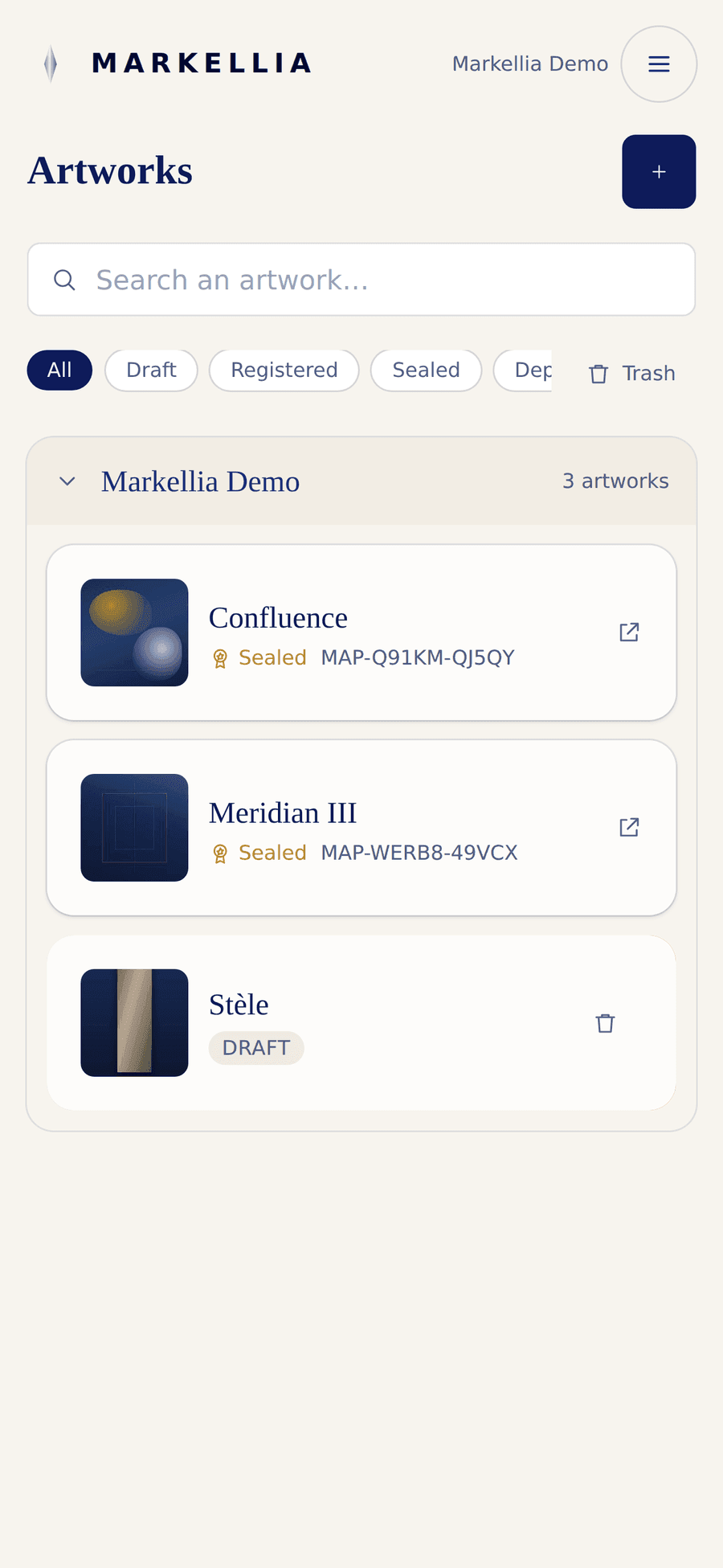
Your collection, work by work: sealed passport or draft. 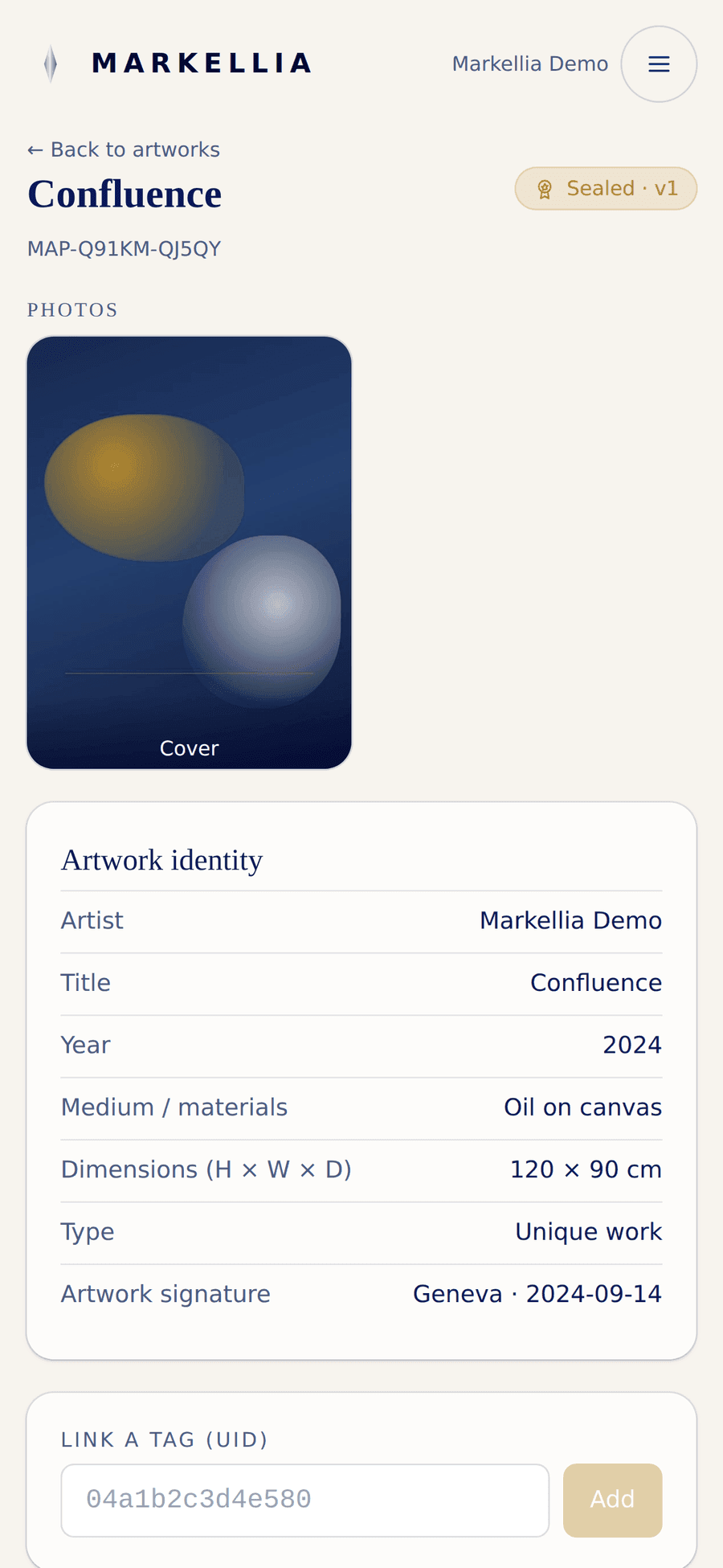
A sealed work's record: photos, identity, version.
A plain PDF, verifiable anywhere
- 6.1
Verifiable without account or software
The sealed document is a PDF in PAdES format, the European standard for signed PDFs: it verifies in any standard PDF reader. No account, no software to install, no connection to Markellia.
- 6.2
Independent of us
The validity of the document depends neither on a platform, nor on Markellia, nor on any continuing commercial relationship.
- 6.3
Qualified timestamp, advanced seal
Each document is sealed with an advanced electronic seal and dated by a qualified electronic timestamp. The timestamp is issued by Swisscom Trust Services, a qualified trust service provider under the European eIDAS Regulation, through the Swiss Trust Layer sealing infrastructure.
A file that travels, confidentiality that stays
A Passport passes through several successive holders. The service is built on a simple principle: each decides what to make visible, and to whom.
- 7.1
The holder keeps control of access
Opening the file to a buyer, an insurer or an institution remains the holder's decision, taken file by file.
- 7.2
Share without exposing everything
Disclosure may cover the complete file, or only the demonstration that the chain is unbroken and that no stage has been removed.
- 7.3
Markellia exposes nothing
No inventory, no collection and no holder name is published or made accessible to third parties.
For institutions and foundations
A collection is rarely documented at the moment it should be. The Passport gives a dated foundation to what already exists.
- 8.1
The documented collection
A file sealed work by work, a dated reference point to which later additions attach. Its object categories follow the thesauri museums use: an institution reads it as it reads its own records.
- 8.2
Loans and movements
Condition reports sealed at a loan's arrival and return: date and content are fixed for both parties. The registrar's process does not change: the report they already produce is the one that gets sealed.
- 8.3
Succession and continuity
Documenting while the artist can still confirm is the most reliable basis for a future catalogue raisonné, and prepares the handover to the structure that will take over.
- 8.4
Restitution
Provenance research produces documents. Sealing fixes what has been established, and the date on which it was.
- 8.5
Offer the Passport to your artists and members
Gallery, foundation, association, federation: offer the Passport to those you represent. For a gallery it is even the first step: opening the Passport with the artist, in the studio, while the documentation still exists. Markellia operates the registry and has each stage sealed and timestamped, the timestamp being issued by a qualified trust service provider; you keep the relationship with your artists and members.
Pilot cohort: ten places
Artists, galleries and institutions put the service to the test in real conditions before its commercial launch. The terms of participation are set out in a written agreement, before you sign.
Apply